
One of the main features of blockchain-based money is programmability - which allows condition-based payments to occur. Money is often not just a transfer of value, but a signal of a certain intent for something to occur, or signal that something has been triggered. In other words, it is a transfer of value with a message. Money also has intended audiences; government-backed money does not want to land in the hands of criminals and launderers, and subsidies may want to target certain subsets of the population and no-one else.
In this article, we explore Purpose Bound Money as a framework for condition-based payments. Purpose Bound Payments – in some cases – may be a more practical implementation for voucher, point or payout-based stores of value.
We start by detailing the first two common types of conditional payment implementations: 1) Programmable Money and 2) Programmable Payments, before detailing Purpose Bound Money and its use cases for government payouts, gift vouchers and point systems.
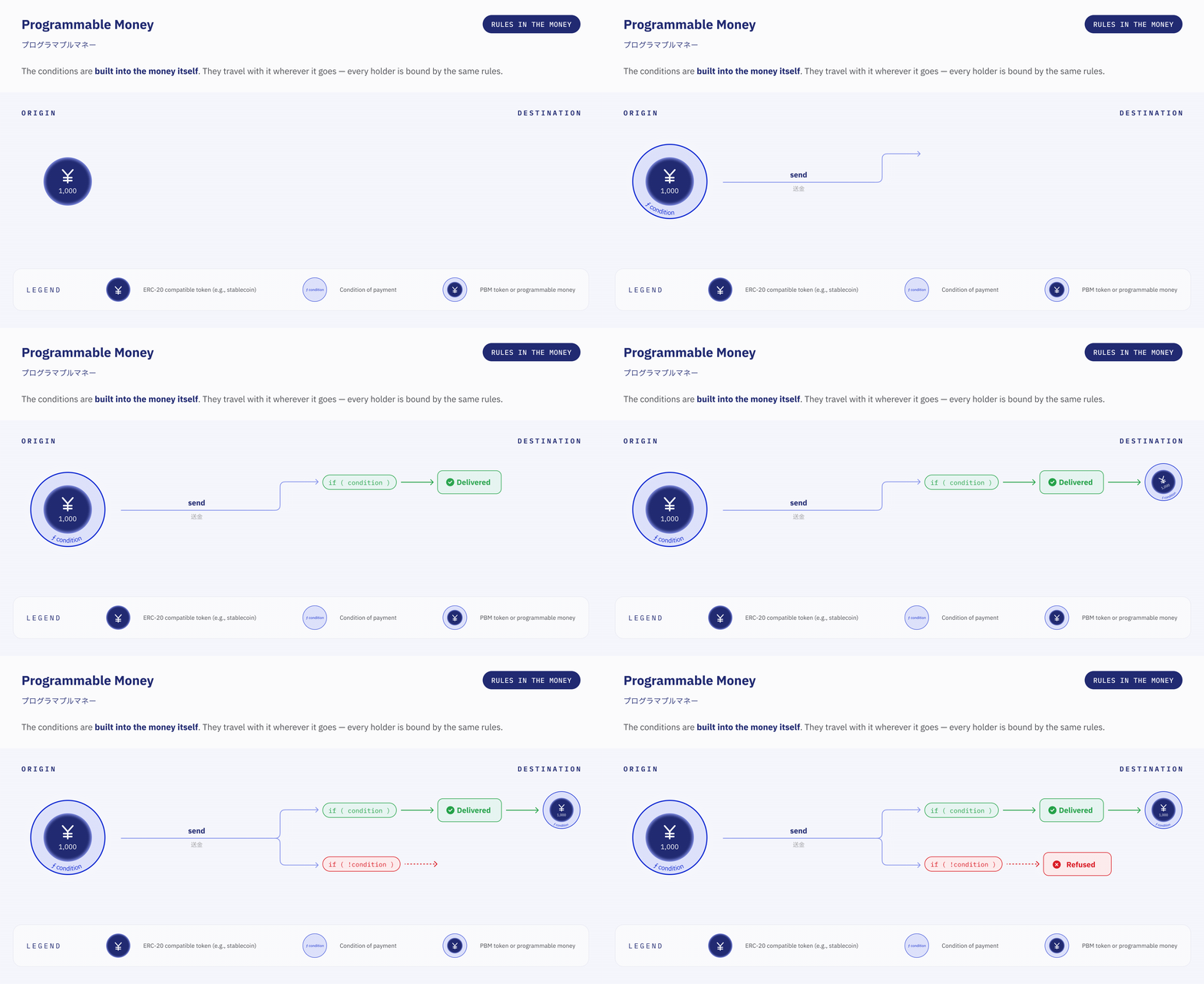
Programmable Money
Programmable money is when the conditions are built into the money itself. One example is the MUSD contract on MIZUHIKI - which requires that the sender and receiver addresses hold a soulbound token representing legal KYC in Japan. One problem with this model, however, is that the store of value cannot be transmitted to those without a “KYCed” wallet, which violates principles of the “singleness of money” -i.e., the transmutability, portability and fungibility which are key to modern-day currencies holding their value.
Programmable Payments
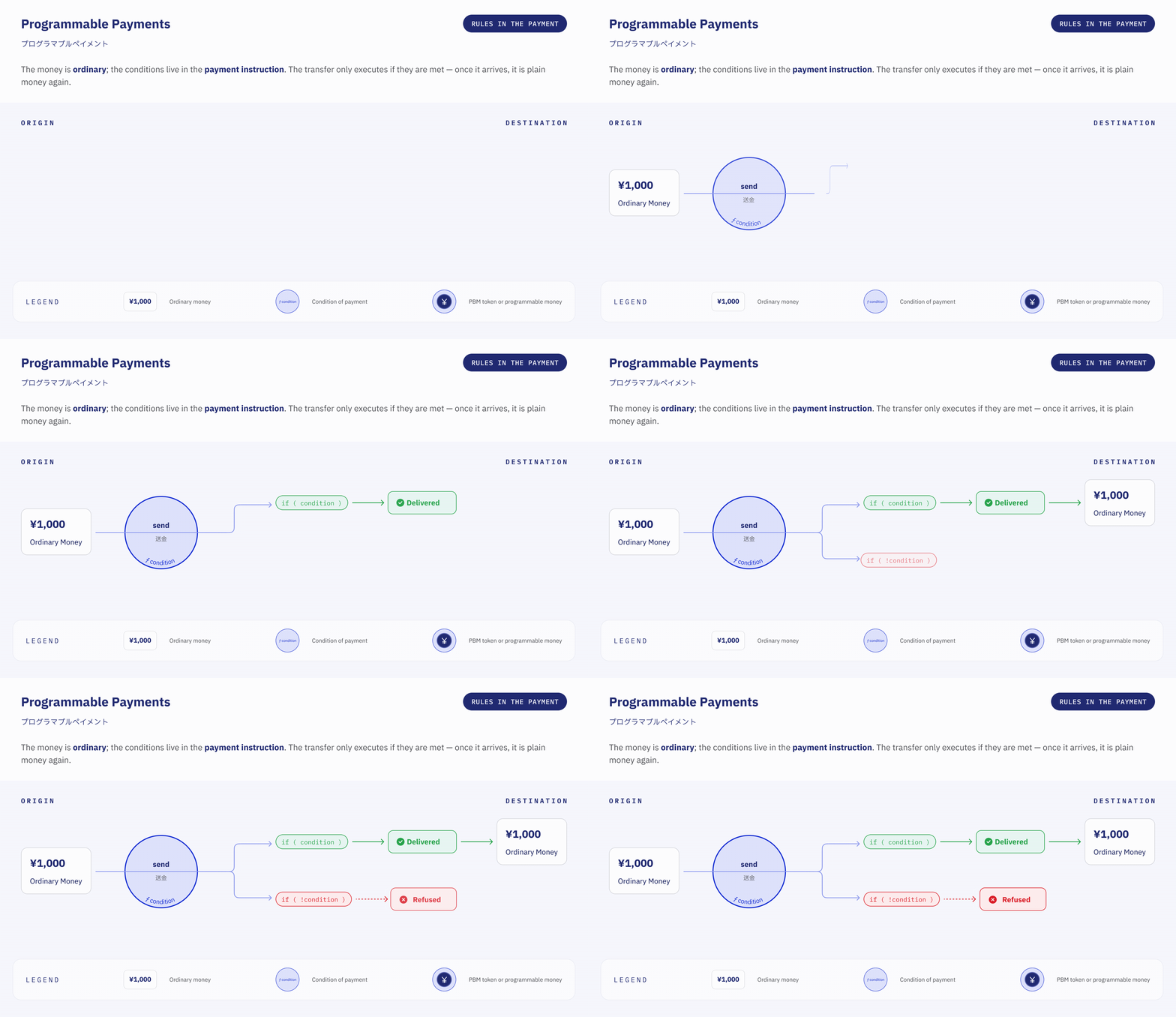
Another type of condition-based stores of value are programmable payments. Programmable payments are assets - including money - that are unlocked and/or transferred when a certain condition is attained. Since the asset itself is not conditioned, the logic lives within the holder’s smart contract at time t. This type of mechanism is ideal when the holder has very defined payment instructions towards a particular action or intended recipient, but ultimately allow the receiver to use the asset freely - without condition - as soon as it has been transferred over - since the money itself has no conditional logic embedded into it.
The perfect use case for programmable payments are those of escrow or trading: in escrow, a holder wants to release the money when a certain condition has been met, such as the delivery of a physical good or the achievement of a certain milestone in a legal agreement.
In trading, a payment may be executed when a stock reaches a certain price point - this kind of logic has existed for decades, but is computationally more efficient when implemented as an on-chain programmable payment (evidence of this claim is apparent in the success of the on-chain trading protocol Hyperliquid, which recently just surpassed the NASDAQ in trading volume. Hyperliquid is run by a small team of 11 people and was founded in 2020).
Purpose Bound Money
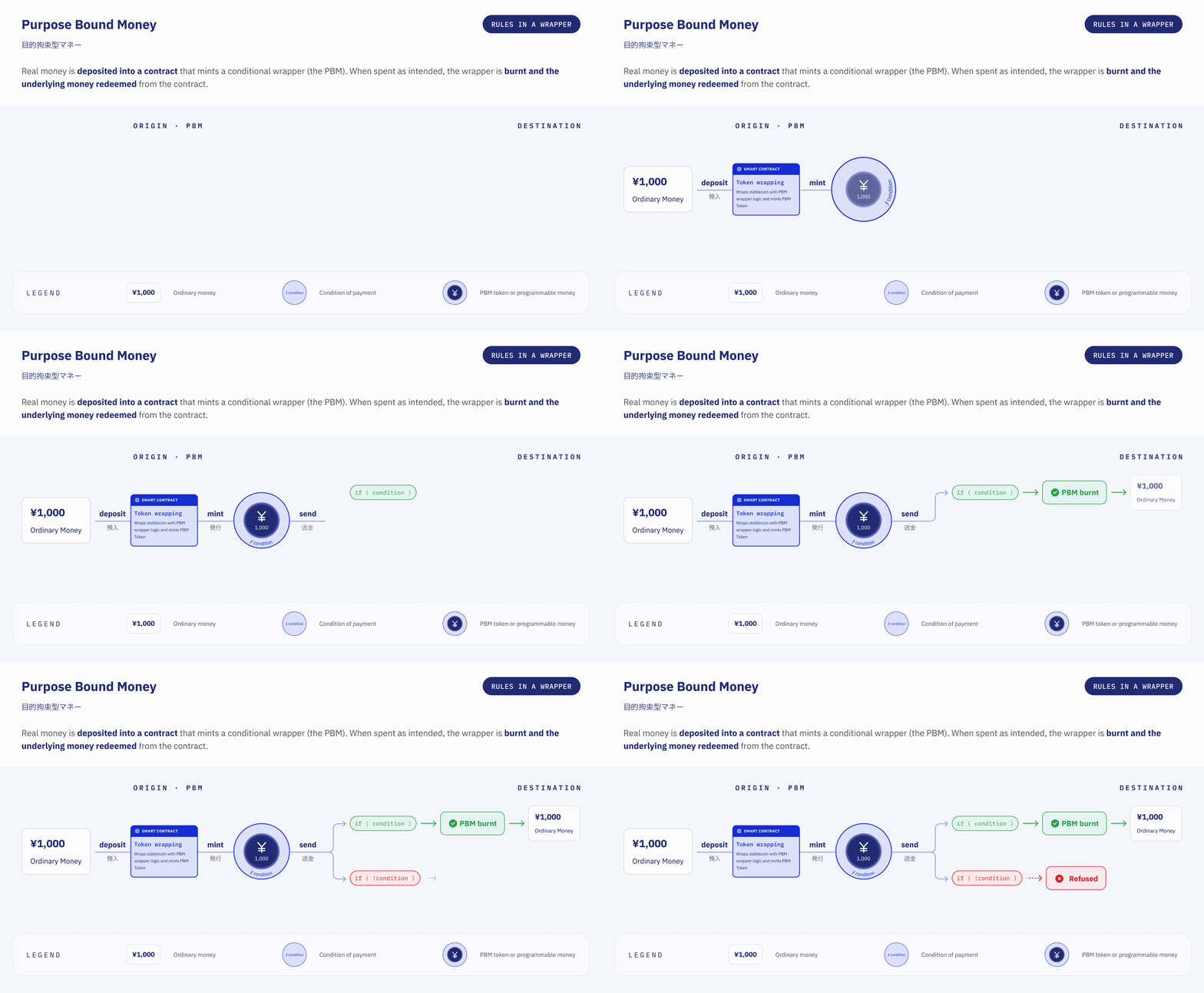
Purpose-bound money is ideal for conditional payments that have a one-to-many distribution model. The simplest way to elucidate the functionality of purpose-bound money is to start with its perfect use case: government payouts.
In Japan, government payouts are fairly commonplace: these may be handouts paid out by municipality to support local businesses, or to simply hand out retirement benefits to the elderly.
Recently, due to higher-than-anticipated inflation, ¥10,000 distributions have been handed out per municipality in Tokyo: to claim these voucher-type distributions, residents had to download new applications, undergo KYC, and merchants needed to apply and install receiver infrastructure to redeem these vouchers.
With purpose-bound money, KYCed recipients (via MIZUHIKI ID infrastructure) can be issued a freshly minted wrapped token, a token that has conditional logic that permits the underlying ERC 20 to be only redeemed at local businesses within a certain area. The receiving local business need not touch or redeem the PBM token - a token which is fairly undesirable as a store of value since its spending restrictions are so limited: instead, upon redemption, the business receives ordinary stablecoins from the PBM issuer smart contract and the spent PBM is automatically burnt.
Other use-cases for Purpose-Bound Money
Gift Vouchers
Suppose we have vouchers that have pre-defined rules that:
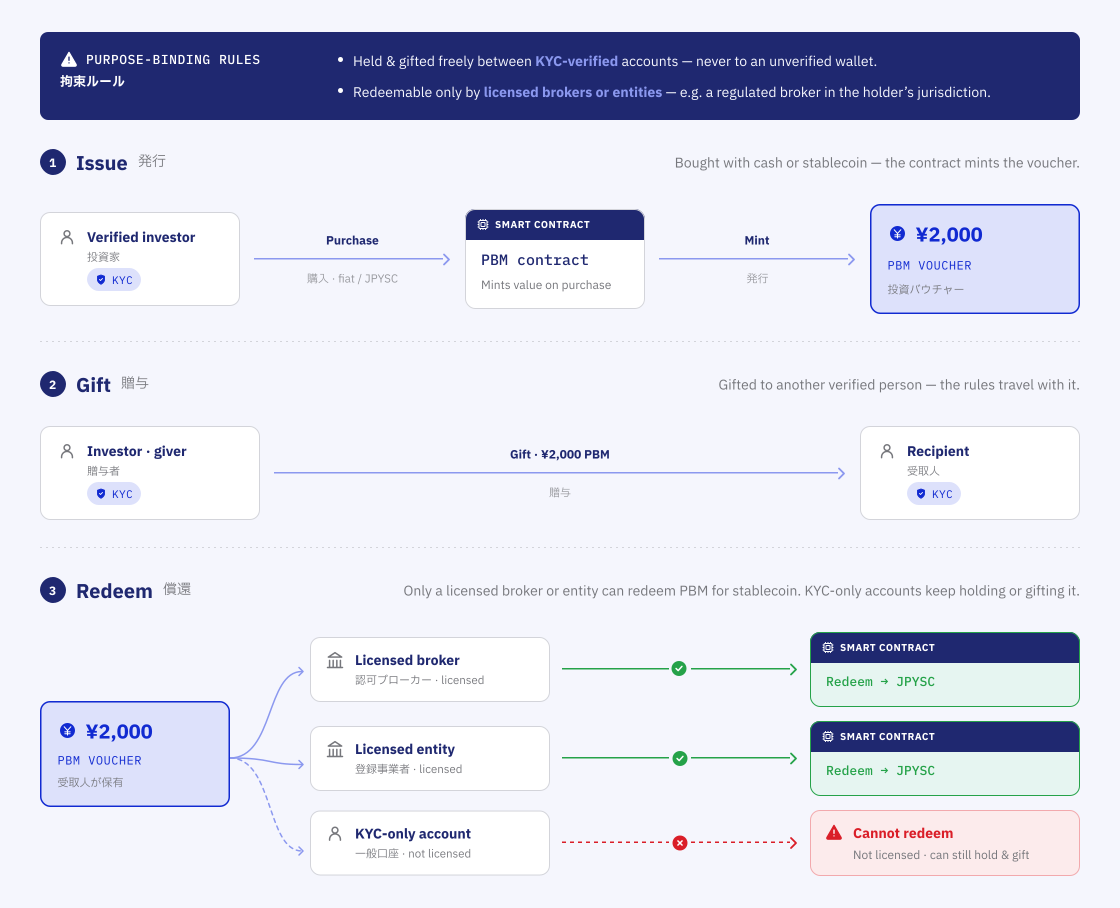
- the voucher can only be held and transferred by KYCed entities - never to an unverified wallet.
- the voucher is redeemable only by approved entities (i.e., registered brokers) that are part of the voucher programme.
Traditional gift cards are closed-loop and unsafe to transfer (due to fraud and/or grey markets). PBM lets rules travel with the voucher - and the issuer holds the float as a stablecoin in the PBM smart contract.
The following use case depicted in the diagram shows the case of investment gift vouchers, which are currently not commonly found due to fraud and AML issues: investment brokers have strong AML obligations and redeeming vouchers from unknown sources would land them in a legally grey area.
However, with Japan's Doubling Asset-based Income Plan - a government plan to encourage residents to shift cash or deposit-based savings to more active investments - there are real incentives to provide easier ways of gifting investment vouchers to friends and family in order to access tax-incentivised, retail investment channels. PBM can act as a voucher with embedded rules that require its redeemer to be an accredited licensed entity, while also ensuring that the transfer of vouchers is trackable (fulfilling AML obligations) and only held by KYCed individuals.
Airline Credit Card Points
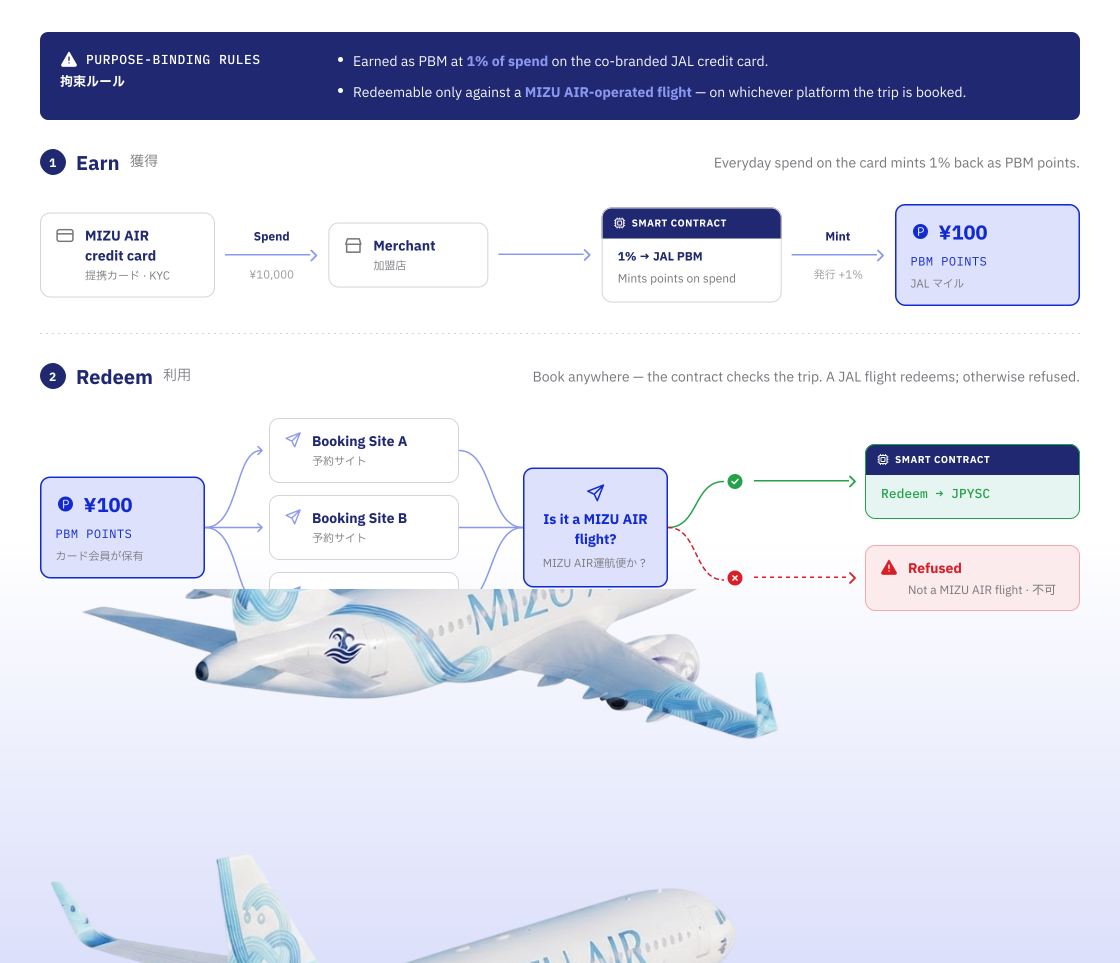
Credit card points are especially big in Japan and the United States. Typically, a user of a credit card in these regions can expect about 0.5% to 2% cashback on total spend in the form of credit card points. Credit card companies will have different types of cards and programmes for users who wish to accumulate points that can be spent in a certain category: a popular category is airline points, where credit card users will choose to accumulate points that can be only spent on buying flights or upgrading their seats.
Partner airlines benefit by creating a loyalty channel and selling the "mile" value upfront to the card issuers - a form of deferred revenue. Airlines also benefit from breakage and devaluation: that is, when users cannot use their points properly leaving them unredeemed or untransferred, or the points become devalued by the airline increasing the purchase thresholds, and so on.
However, airlines have come under fire by both US regulators and their customers for devaluing points in this format.
In September 2024, the United States Department of Transportation opened up an inquiry into loyalty points devaluation, specifically for 1) devaluation of earned rewards, 2) hidden and dynamic pricing, 3) extra fees, and 4) reduction in competition and choice through airline mergers. While the inquiry turned out to have few legally-mandated reforms for airlines, it did confirm customers' concerns around airline and point loyalty system degradation, which has deeper effects on customer loyalty and trust in the airlines.
Crucially, purpose-bound money allows airlines to generate deferred revenue from upfront point-sales, but eliminates the breakage and devaluation of the point system. In return, however, the point system functions as a more reliable currency-like product, which may command a higher price from card issuers. While the point-system business model changes, it does not necessarily imply decreased profits for the airlines, while almost certainly guaranteeing a greater user experience for credit card and airline customers.
Airlines offering points that guarantee transferability and more limited options to point devaluation, such as through a purpose-bound money system, are likely to attract a better loyalty base than competitors who do not adopt such systems.